





 SALES
SALES






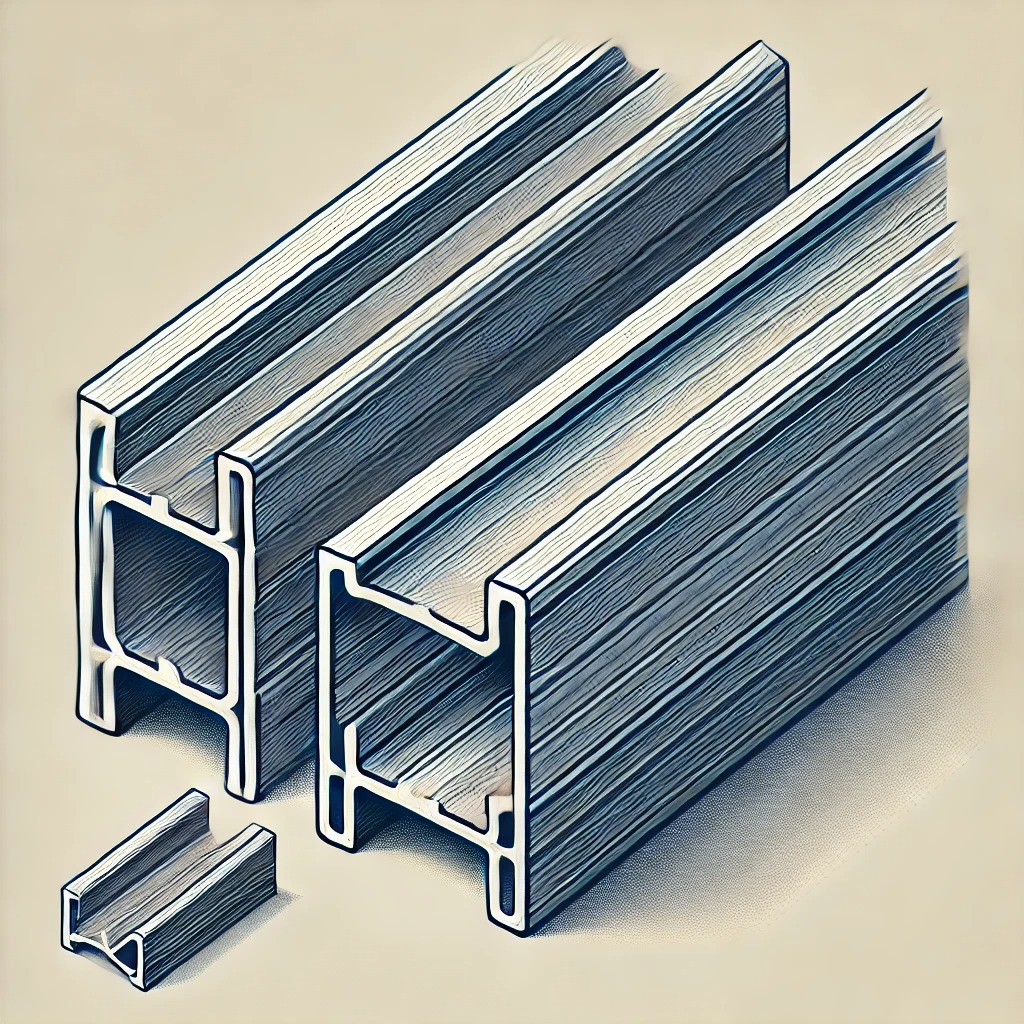
H-beams, also known as wide flange beams or simply "H sections," are a type of steel beam with a wide H-shaped cross-section. They feature a vertical web connected to horizontal flanges at the top and bottom. H-beams are widely used in construction and mechanical engineering for various load-bearing and structural applications. Typically, H-beams are made from carbon steel, although alloy steels or aluminum may be used depending on specific project requirements. The appropriate size and type of H-beam are determined by engineering calculations and project-specific factors, including load demands, span lengths, and environmental conditions.
Key Features:
- H-shaped cross-section: H-beams have an “H” shape with two horizontal flanges connected by a vertical web. This configuration provides high strength and stability.
- High strength-to-weight ratio: H-beams are designed to efficiently support heavy loads and distribute weight across the flanges, helping prevent buckling and deformation.
- Variety of sizes: H-beams come in various sizes, offering flexibility to meet specific engineering requirements.
- Standardized profiles: They are often manufactured according to established standards, making them easy to use by engineers and builders.
Applications:
- Building construction: Widely used as beams, columns, and frame supports. They play a vital role in the structural integrity of buildings, supporting floors, roofs, and walls.
- Bridges: Used in bridge construction to support roadways and pedestrian paths and enable spans.
- Industrial facilities: Used in warehouses, factories, and plants to support heavy equipment, cranes, and storage systems.
- Residential construction: Employed in load-bearing walls, floor joists, and roof trusses.
- Infrastructure projects: Used in tunnels, railway systems, and airports to support large areas and structures.
- Material handling systems: Applied in overhead cranes, conveyors, and other equipment for moving heavy loads.
- Shipbuilding: Provide structural support for ships and marine constructions.
- Aerospace industry: Used in aircraft construction, especially in fuselage, wings, and landing gear assemblies.
- Automotive manufacturing: Used for vehicle frames and chassis components.
- Mechanical engineering and structural design: Employed in a wide range of applications where load-bearing capacity is critical for stability and safety.
HEA, HEB, and HEM Series:
HEB, HEA, and HEM are different types of European standard beams used in construction and engineering. Each profile has specific cross-sectional shapes and sizes defined by European standards. These profiles are commonly used in Europe and regions that adopt European steel construction standards.
|
Profile |
Full Name |
Section Characteristics |
Typical Applications |
|
HEA |
European Light Wide Flange Beam |
Wide H-section with parallel flanges and straight web |
Light structures, load-bearing walls, columns, and building frames |
|
HEB |
European Standard Wide Flange Beam |
Thicker flanges than HEA, parallel flanges, straight web |
Standard loads, versatile use in buildings and bridges |
|
HEM |
European Heavy Wide Flange Beam |
Very thick flanges, parallel flanges, straight web |
Very heavy loads, large industrial buildings, bridges, portal cranes |
Differences between HEA, HEB, and HEM:
|
Parameter |
HEA |
HEB |
HEM |
|
Weight (kg/m) |
Low |
Medium |
High |
|
Flange Thickness |
Thinner |
Medium |
Thick |
|
Load Bearing Capacity |
Good |
Higher |
Very High |
|
Application |
Light structures |
General purpose |
Heavy, highly loaded structures |
Standards:
|
Standard |
Description |
|
EN 10034 |
Geometric tolerances for I and H beams |
|
DIN 1025-3 |
Specification for HEA profiles |
|
DIN 1025-4 |
Specification for HEB profiles |
|
DIN 1025-5 |
Specification for HEM profiles |
|
GOST 8239 |
Russian standard for IPN series beams |
Typical applications:
- HEA: load-bearing walls of residential and commercial buildings, columns, frame structures.
- HEB: industrial buildings, bridges, platforms, heavy equipment.
- HEM: heavily loaded foundations, extra-heavy structures, infrastructure supports, portal cranes, shipbuilding.